
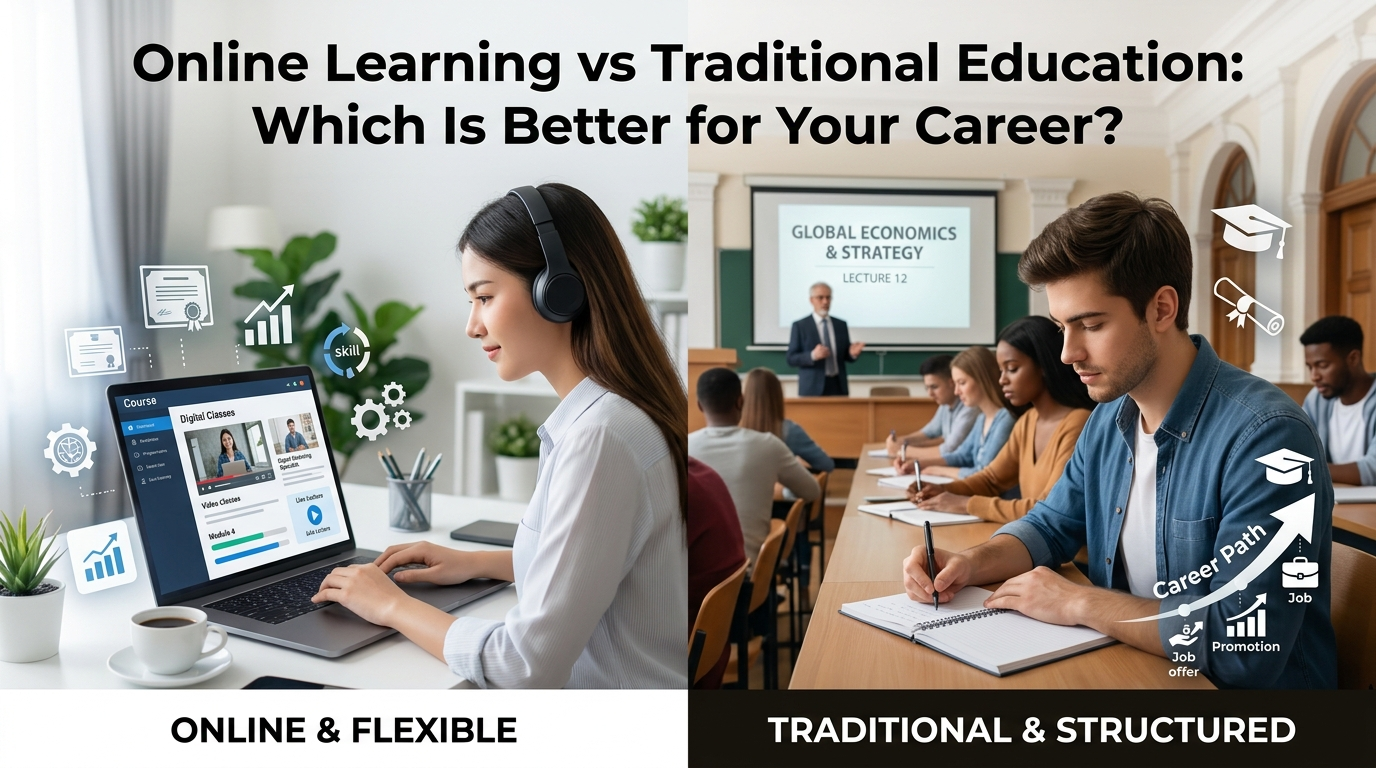
A decade ago, the answer to this question was simple. Traditional education meant sitting in a lecture hall, taking handwritten notes, and earning a degree the conventional way. Online learning, on the other hand, was seen as the “easier” cousin — convenient but rarely respected.
That world has changed. Today, top universities like Oxford, Harvard and IIT offer fully accredited online programmes, and millions of working professionals are upgrading their skills from their living rooms. So, which path is genuinely better for your career? Let’s break it down honestly.
What Is Online Learning?
Online learning, or e-learning, is any form of education that takes place over the internet. This includes recorded video lectures, live webinars, interactive assignments, and virtual classrooms. Platforms like Coursera, edX, Udemy and Khan Academy have made structured learning available to anyone with a stable internet connection.
The biggest shift in the last few years has been the rise of micro-credentials — short, focused courses that teach a specific skill in weeks rather than years. These are increasingly being recognised by employers as proof of competence.
What Is Traditional Education?
Traditional education refers to the classroom-based learning model that has dominated for centuries. Students attend a physical institution, follow a fixed timetable, interact face-to-face with tutors, and graduate with a recognised degree.
Despite the rise of online options, traditional education remains the foundation of formal qualifications worldwide — particularly for fields like medicine, law and engineering, where in-person training is essential.
Online Learning vs Traditional Education: The Key Differences
1. Flexibility and Convenience
Online learning wins this category outright. You can study at midnight in your pyjamas, pause a lecture when your child needs you, or finish a course while commuting. This flexibility is a game-changer for working professionals, parents and anyone with a busy life.
Traditional education, by contrast, demands a fixed schedule. You attend class at set times, in a set place, regardless of your other responsibilities.
2. Cost
Online courses are usually much cheaper. A solid online certification might cost you £20 to £200, whilst many high-quality courses on platforms like Coursera and edX are entirely free if you don’t need a certificate.
A traditional degree, on the other hand, can cost anywhere from £9,000 to over £40,000 in the UK, plus living expenses. For many learners, this is a significant financial commitment.
3. Quality of Interaction
Traditional education has the upper hand here. Classroom discussions, group projects and direct access to tutors create a richer interactive experience. You build friendships, develop people skills and benefit from spontaneous learning moments that are harder to replicate online.
Online learning is improving in this area through forums, live Zoom sessions and peer review systems, but it still cannot fully replace the depth of in-person interaction.
4. Recognition by Employers
This is where things have shifted dramatically. Five years ago, an online certificate might have been treated with scepticism. Today, employers actively favour candidates who demonstrate a habit of continuous learning through platforms like LinkedIn Learning, Google Career Certificates or Coursera Specialisations.
That said, for regulated professions — doctors, lawyers, engineers — a traditional degree from an accredited institution is still essential and non-negotiable.
5. Self-Discipline Required
Online learning demands strong self-discipline. Without fixed deadlines and a physical classroom, it is easy to procrastinate or quit halfway through a course. Studies show that completion rates for free online courses are often below 15 percent.
Traditional education has built-in accountability. Attendance, deadlines and exams force you to keep going even when motivation dips.
6. Career Networking
Universities offer something that is hard to recreate online — a community. Alumni networks, campus events and lifelong friendships often open doors that no online course can. If networking is critical to your career path, traditional education has a clear advantage.
That said, online learners can still build powerful networks through LinkedIn, virtual study groups and online community platforms like Discord and Slack.
Which One Should You Choose?
The honest answer is: it depends on your goals.
Choose online learning if you want to:
- Upskill quickly without quitting your job
- Save money and learn at your own pace
- Switch careers into tech, marketing, design or freelancing
- Add specific certifications to your CV
Choose traditional education if you want to:
- Earn a formal degree in regulated fields like medicine or law
- Benefit from face-to-face mentorship and campus life
- Build a strong professional network from a young age
- Have structured accountability throughout your studies
The Hybrid Approach: The Best of Both Worlds
In 2026, the smartest learners are choosing a hybrid path. They earn a traditional degree for foundational knowledge and credibility, then continuously top it up with online courses to stay relevant. A graduate with a traditional engineering degree plus an online specialisation in artificial intelligence, for example, is significantly more employable than one with either alone.
Final Thoughts
There is no single winner in the online learning vs traditional education debate. Both have unique strengths, and the right choice depends entirely on your career goals, budget, and learning style.
The most important thing is to keep learning — whatever the format. The world of work is changing faster than ever, and the people who thrive are not the ones with the fanciest degrees but the ones who never stop adding to their skill set.
Whether you choose a campus, a screen, or both, the real investment is in yourself.