
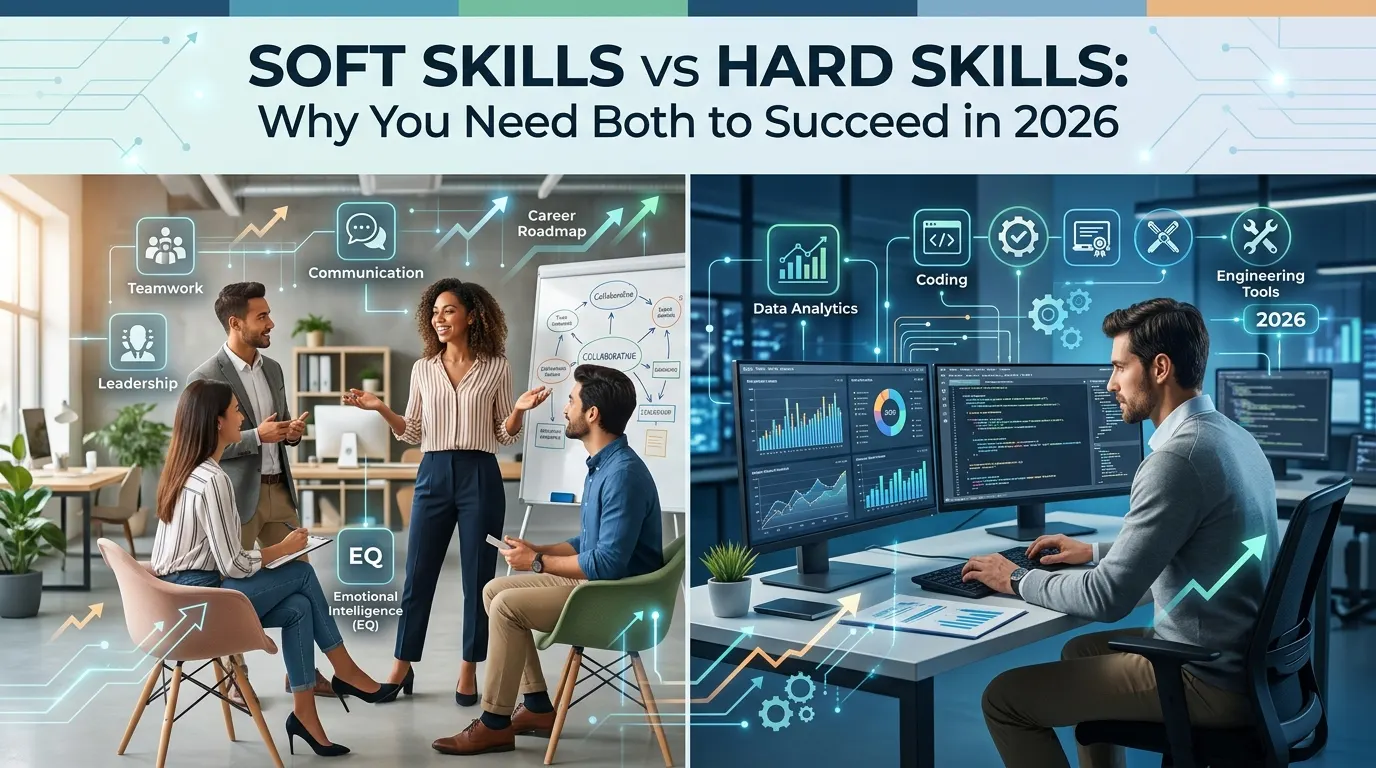
If you’ve ever applied for a job, attended a training programme, or read a career article, you’ve heard the terms soft skills and hard skills. Most people understand them vaguely, but few realise just how differently they work — or how the most successful professionals deliberately develop both.
In this guide, we’ll break down what soft and hard skills actually are, why both matter more than ever in 2026, and how you can build a balanced skill set that opens real career opportunities.
What Are Hard Skills?
Hard skills are the technical, measurable abilities you can prove through tests, certifications or demonstrated work. They are the “what” of your job — the specific knowledge required to perform tasks.
Examples of hard skills include:
- Coding in Python, JavaScript or SQL
- Using Microsoft Excel, Power BI or Tableau
- Speaking a foreign language
- Operating machinery
- Accounting or bookkeeping
- Graphic design with tools like Adobe Photoshop or Figma
- Data analysis and statistical modelling
- Digital marketing and SEO
Hard skills are typically learned through formal training: courses, degrees, certifications, manuals or hands-on practice. You can usually point to evidence of them — a certificate, a portfolio, a test score.
What Are Soft Skills?
Soft skills are the personal qualities, social abilities and habits that determine how you work, how you behave and how you interact with others. They are the “how” of your job.
Examples of soft skills include:
- Communication
- Active listening
- Teamwork and collaboration
- Adaptability and flexibility
- Emotional intelligence
- Problem solving
- Time management
- Leadership
- Conflict resolution
- Creativity and curiosity
Soft skills can be harder to measure, but they are visible the moment you start interacting with someone. Often they are the deciding factor in promotions, leadership opportunities and long-term career growth.
Soft Skills vs Hard Skills: The Key Differences
| Aspect | Hard Skills | Soft Skills | |——–|————-|————-| | Nature | Technical, measurable | Personal, behavioural | | How they’re learned | Courses, training, certifications | Practice, feedback, life experience | | How they’re proven | Tests, portfolios, certificates | Behaviour, references, interviews | | Time to develop | Weeks to years | Lifelong development | | Transferability | Often role-specific | Highly transferable across roles |
Both are essential — but they answer different questions about you as a professional. Hard skills answer, “Can you do the job?” Soft skills answer, “Will you be great to work with while doing it?”
Why Hard Skills Get You Hired
In most jobs, hard skills are the entry ticket. If you can’t write code, you can’t be a software developer. If you can’t operate a CNC machine, you can’t be a CNC operator. If you can’t analyse a balance sheet, you can’t be an accountant.
Hard skills are how recruiters filter candidates. CVs, certifications and technical interviews are designed to verify them. Without the right hard skills, you don’t even get through the door.
Why Soft Skills Get You Promoted
Once you’re in the door, the rules of progression change. Two engineers might have identical technical skills, but only one will be promoted to lead the team. The difference is almost always soft skills.
Soft skills decide:
- Whether you can lead and inspire others
- Whether colleagues enjoy working with you
- Whether clients trust you with bigger contracts
- Whether you remain calm under pressure
- Whether you can communicate complex ideas to non-experts
In senior roles, soft skills become the dominant factor. Most failed leaders fail not because they lacked technical knowledge, but because they couldn’t manage relationships, communicate vision or handle conflict.
Why You Genuinely Need Both
Some career advice frames soft skills and hard skills as opposites — as if you must choose. The reality is that they work together. Each amplifies the other.
- A great communicator (soft) who doesn’t understand the data (hard) gives confident but wrong presentations.
- A brilliant data analyst (hard) who can’t explain insights clearly (soft) is ignored by decision-makers.
- A talented coder (hard) who doesn’t collaborate well (soft) frustrates the whole team.
- A charismatic leader (soft) without business knowledge (hard) makes inspiring but harmful decisions.
The most valuable professionals in 2026 are T-shaped: deep technical expertise in one or two areas, supported by strong horizontal soft skills across communication, collaboration and leadership.
How AI Is Reshaping the Balance
Artificial intelligence is automating many traditional hard skills — writing code, summarising documents, analysing data, designing graphics. As a result, the relative value of soft skills is rising.
You no longer need to memorise as much. You need to know how to:
- Ask great questions of AI tools
- Critically evaluate AI-generated outputs
- Lead teams through change
- Build relationships with clients
- Make wise decisions amid uncertainty
In other words, even as hard skills evolve, soft skills become more important, not less.
How to Develop Hard Skills
Hard skills are built systematically. Here’s a simple roadmap:
- Identify the specific skill you need — not a general topic, but a clear capability (“write SQL queries to analyse sales data”).
- Find a structured course or programme — Coursera, Udemy, edX, certifications.
- Practise on real projects, not just exercises.
- Build a portfolio that proves your ability.
- Get certified if employers in your industry value it.
Pick one or two hard skills relevant to your career and go deep, rather than collecting many shallow ones.
How to Develop Soft Skills
Soft skills are trickier — they grow through practice, reflection and feedback rather than courses alone. Try this:
- Read widely — books on communication, leadership and emotional intelligence
- Practise deliberately — choose one soft skill at a time and focus on it for a month
- Ask for feedback — colleagues, mentors, friends. Listen without defensiveness
- Reflect after key interactions — what went well, what could improve
- Put yourself in stretch situations — public speaking, leading a meeting, mentoring someone junior
Books worth starting with: *How to Win Friends and Influence People* by Dale Carnegie, *Crucial Conversations* by Patterson et al., and *Emotional Intelligence* by Daniel Goleman.
How to Show Both on Your CV
A common mistake is to only list hard skills on your CV and assume soft skills will be visible later. Instead:
- Hard skills — list them in a dedicated skills section, plus describe how you used them in each role
- Soft skills — show them through achievements (“led a team of 6”, “presented to senior leadership”, “resolved a major client conflict”)
Don’t just write “good communication skills.” Demonstrate it through specific results.
Final Thoughts
The soft skills vs hard skills debate is a false choice. Successful careers are built on both — hard skills that prove you can do the work, and soft skills that prove you can do it well alongside others.
If your career feels stuck despite strong technical knowledge, your soft skills are likely the bottleneck. If you can charm anyone but lack technical depth, hard skills are your next focus.
Build them together — deliberately, consistently, and with self-awareness — and you’ll quietly outpace competitors who specialise in only one. In the modern workplace, that balance is the real secret to standing out.